

When the Benefits Stop at the County Line
When tax revenue lands in one county but the burden falls next door

Author’s note: What keeps striking me is how often these debates are framed as local opposition or simple yes-or-no fights. The deeper question is usually more practical: was the right community ever in the room? Who gets counted as part of the project, who is asked to live with the trade-offs, and who gets a voice before the decision is effectively made?
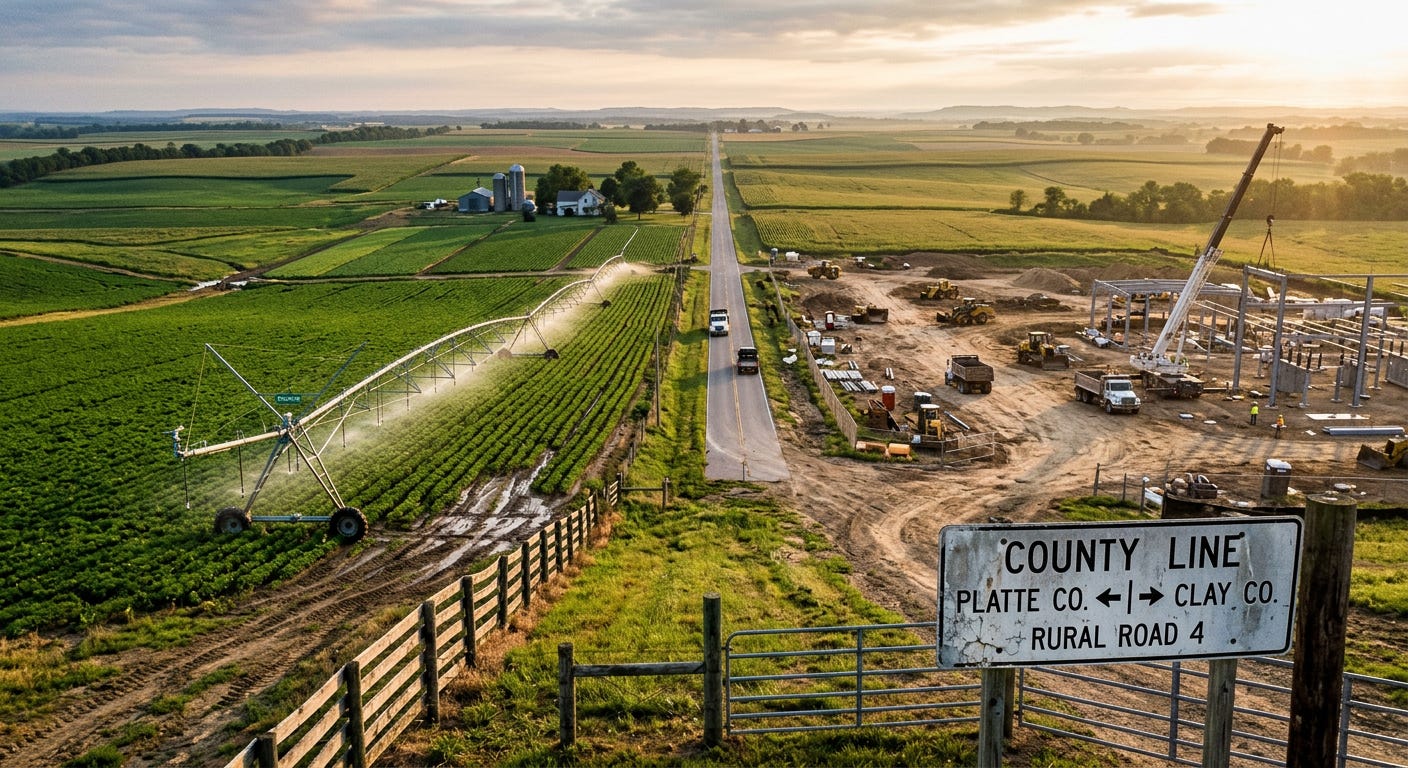
Major infrastructure projects are increasingly running into a basic political problem: the people who absorb the impacts are not always the people who collect the benefits.
When a developer pitches a hyperscale data center, a high-voltage transmission line, or a utility-scale solar project, the conversation often begins with a familiar exchange. The developer promises private investment, construction activity, jobs, and a larger tax base. In return, the host county approves a permit, rezoning, or siting agreement.
On paper, this is the standard host-community bargain. In practice, it is often too narrow.
But infrastructure impacts do not stop at municipal boundaries.
A county line drawn generations ago does not protect a shared aquifer. It does not keep a transmission corridor from cutting across a farm that does not consume the power. It does not prevent neighboring emergency responders, homeowners, water systems, and motorists from absorbing the consequences of a project they had little or no voice in approving.
That mismatch is creating a more visible category of infrastructure resistance: the rise of the impact community.
An impact community is any neighboring jurisdiction, city, district, or local system that carries the physical, environmental, or operational burden of a major development while receiving little or none of the direct tax revenue.
For developers, utilities, and public officials, this is no longer a side issue. Ignore impact communities, and a project that looked politically settled can quickly become a lawsuit, a regional water fight, a permitting standoff, or a decade-long operating headache.
Once you start looking for this pattern, it shows up everywhere.
Two Flashpoints Show the Problem
The impact-community problem is not theoretical. It is already showing up in disputes over data centers, transmission lines, and renewable-energy siting.
When Water Crosses County Lines
In Sangamon County, Illinois, officials approved a major data center project near Waverly. Supporters emphasized the economic-development upside: investment, property-tax revenue, and a new industrial anchor for the county.
The geography complicated the politics. The site sits near Waverly, a community just across the line in neighboring Morgan County. That meant the county positioned to receive much of the tax upside was not necessarily the same community most exposed to questions about water, land-use compatibility, and adjacent-property impacts.
Residents near the site sued Sangamon County and the county board, seeking to overturn the approval. The lawsuit challenged the county’s process and argued that the project’s impacts on nearby farms, residences, and local businesses had not been fully understood before approval.
The lesson is straightforward: if a project depends on regional resources, nearby landowners, or neighboring municipal systems, a single-county approval strategy may be legally sufficient but politically fragile.
When Transmission Lines Cross Working Land
A related dynamic appears in debates over high-voltage transmission corridors. Grid planners may see a line as a regional reliability asset. Landowners may experience it as a direct operating impairment, especially when a proposed route crosses working agricultural land rather than unused open space.
When a proposed alignment crosses productive farmland, the burden is not limited to the acreage under the easement. A transmission corridor can disrupt irrigation, crop rotation, equipment movement, food-safety practices, and the daily logistics of harvest.
That is why standard per-acre compensation can miss the real cost. The project is not merely buying access to land. It is changing how that land functions as a business, an operating system, and sometimes a family asset.
Why State Preemption Is Not a Cure-All
When local opposition slows infrastructure deployment, state legislatures often reach for preemption. The logic is understandable. Some projects serve regional or statewide needs, and a purely local veto can make planning nearly impossible.
Michigan’s Public Act 233 is one example. The law created a state-level siting process for certain large wind, solar, and energy-storage facilities through the Michigan Public Service Commission, while allowing local governments to retain authority if they adopt compatible renewable-energy ordinances.
State preemption can help a project obtain a certificate. But a certificate is not the same thing as legitimacy. If a state override becomes a substitute for engagement with impact communities, three risks tend to follow:
· It deepens political hostility: Bypassing local boards can reinforce the belief that rural communities are being asked to absorb industrial costs for someone else’s benefit.
· It invites legal and procedural resistance: Communities that lose one decision point often look for others, from litigation and moratoria to scrutiny of roads, drainage, building permits, and emergency-response plans.
· It creates long-term operating friction: A project built over fierce local objection can face years of permit disputes, strained emergency-response cooperation, and a hostile political environment.
The core point: a project can win the legal process and still lose the community.
The Better Playbook: Regional Benefit Sharing
If infrastructure developers want durable approvals, they need to stop treating the host jurisdiction as the only community that matters.
A modern siting strategy should begin with a regional impact framework before conflict hardens. That framework should include four moves:
1. Map the physical footprint, not just the tax footprint: Identify every municipality that supplies water, manages emergency response, hosts access roads, or shares a viewshed with the facility. Treat those communities as core stakeholders from day one.
2. Use regional benefit-sharing agreements: Move beyond single-town host agreements. If a data center’s water demand affects a neighboring utility, create a binding agreement that helps fund water infrastructure, reservoir work, or rate offsets in the impact community.
3. Assess operational impacts early: For farms and linear infrastructure, look beyond static land appraisals. Evaluate irrigation lines, crop rotation, certification impacts, and equipment access before a preferred corridor is locked in.
4. Fund independent technical advice: Do not expect a small township or water board to rely only on a developer’s projections. Give impact communities resources to hire their own engineers, hydrologists, or safety experts.
Key Takeaways
· The host community is not always the impact community.
· County lines do not contain water, traffic, emergency-response obligations, viewshed disruption, or agricultural operating impacts.
· State preemption can produce a certificate, but not necessarily consent.
· Regional benefit-sharing agreements should become standard practice for large infrastructure projects.
The Bottom Line
Major infrastructure will always involve trade-offs. But asking one community to absorb the risk while another collects the reward is not a durable development strategy.
Projects succeed when their benefits, risks, and responsibilities are aligned across every border they touch. That means developers need to negotiate with the full geography of impact—not just the jurisdiction that signs the permit.
What I’d Like to Hear From You
If this has happened where you live, I’d love to hear the story—not just whether the project was approved, but whether the process felt fair. Where did the benefits land? Who carried the costs? And what would a better regional agreement have looked like?
Leave a comment, share this piece with someone working on infrastructure siting, or send me an example from your region. The more we identify impact communities before conflict hardens, the better chance we have of building projects that are not only approved, but actually accepted.
Reader question: If your community had to host the impacts of a major project without receiving most of the benefits, what would fairness look like to you?
Sources and Reference Notes
Waverly / Sangamon County Data Center Dispute: NPR Illinois & Illinois Times (April–July 2026).
Howard Solstice Transmission Line & Constanzo Farm: San Antonio Express-News (July 2026).
Michigan Public Act 233 Siting Analysis: MCL 460.1221 / Clean & Renewable Energy Act (Effective Nov 2024–2026).
Local Opposition & Transboundary Impacts: Sabin Center for Climate Change Law & Brookings