

When “System Reliability” Starts to Sound Like a Private Subsidy
Why Georgia’s transmission fight is becoming a national story about who pays, who benefits, and who loses their home.

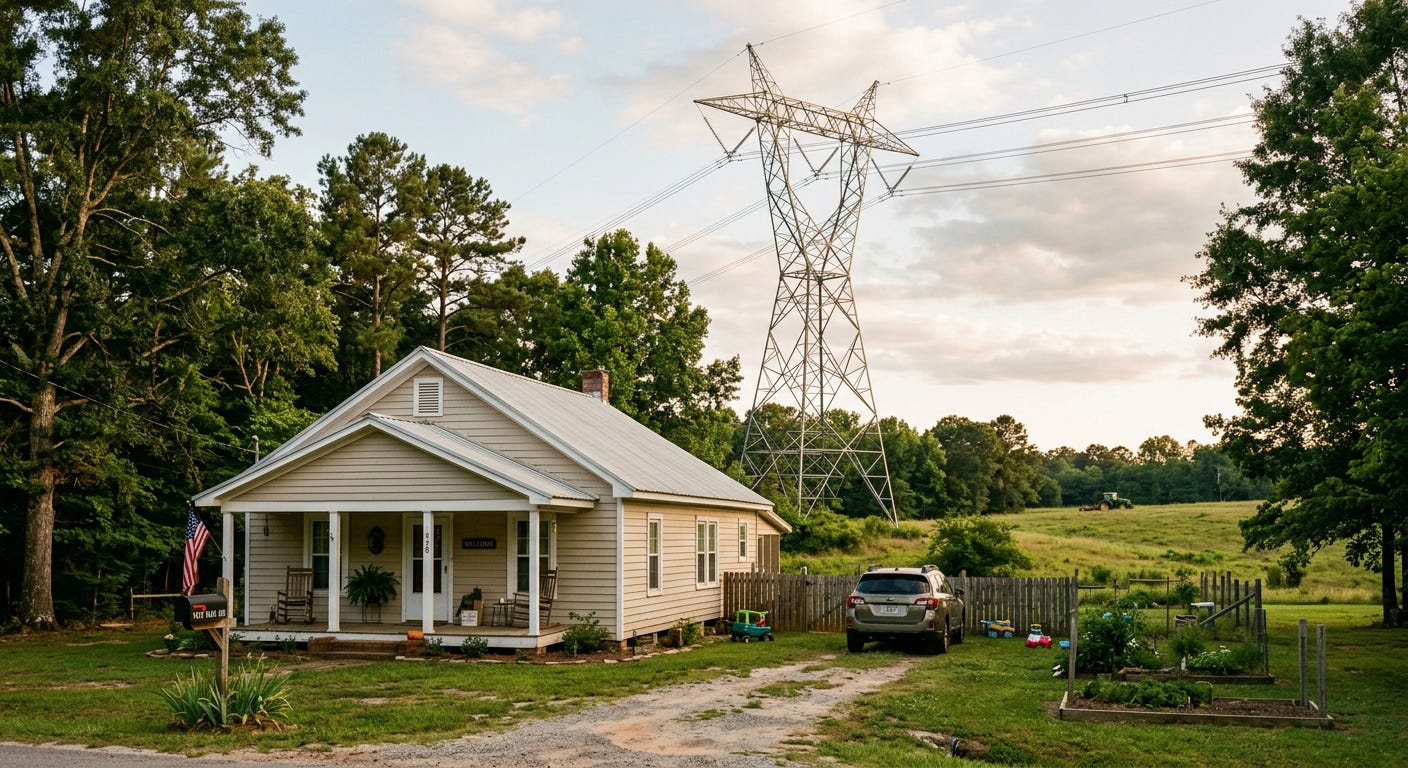
Utilities have long relied on a familiar line when they want to run a high‑voltage transmission corridor through someone’s backyard: It’s for grid reliability.
That used to end the conversation. Reliability meant keeping the lights on. But in 2026, with data‑center growth driving unprecedented electricity demand, communities are asking a sharper question: reliability for whom?
Georgia is now the clearest example of how quickly that question becomes a land‑use battle. A proposed 35‑mile, 500‑kV transmission line connecting the Ashley Park Substation in Fayette County to Plant Wansley in Heard County cuts across more than 300 parcels. Nearly 30 homes could be acquired or removed.
Georgia Power says the project supports regional resilience and system‑wide growth. But families in Coweta, Fayette, Fulton, and Heard counties see a different story: roughly 80% of the utility’s new capacity growth is tied to data centers, according to IRP filings and local reporting.
When a family is asked to surrender their home through eminent domain so hyperscale server farms can expand, broad corporate slogans about “system need” don’t build trust — they ignite a firestorm.
1. The Eminent Domain Legitimacy Trap
Eminent domain is the most severe legal tool an infrastructure provider can use. It exists because linear projects — pipelines, highways, transmission lines — cannot be built parcel‑by‑parcel through voluntary negotiations alone.
But the legal right to condemn property rests on a fragile social contract: people must believe the taking serves a genuine public purpose.
When that line blurs, abstract policy becomes human upheaval.
Consider one Coweta County family. Ansley Brown spent months fighting to keep her mother’s childhood home — purchased two decades ago to build generational wealth — from being taken for the 35‑mile corridor. When residents hear that 70% to 80% of the new capacity is slated for hyperscale data centers, the idea of forcing families out under threat of condemnation doesn’t feel like “regional reliability.” It feels like an institutional land grab.
The Broad Corporate Explanation: Georgia Power frames the Ashley Park–Wansley line as essential to regional resilience and grid health.
The Ground Reality: Landowners see tech giants securing massive power allocations while everyday families carry the physical, financial, and emotional burden of lost homes.
When the perceived commercial beneficiary is narrow and highly profitable, invoking eminent domain without overwhelming transparency destroys local legitimacy. Even adequate compensation cannot fix the political fallout when a family feels their home is being sacrificed to subsidize private tech infrastructure.
2. Why Corporate Jargon Fails on the Ground
When utilities face rural opposition over right‑of‑way acquisitions, the default response is often to double down on engineering models, load‑flow diagrams, and regulatory citations.
This misses the human element entirely.
Landowners do not experience transmission lines as a system‑wide megawatt calculation. They experience them as 150‑foot steel towers outside their bedroom windows, cleared tree lines, disrupted cattle pastures, and reduced property values.
When developers rely on general “system need” language while refusing to break down customer‑class demand, residents assume the worst: that something is being hidden.
3. How to Fix the Transmission Playbook
If clean‑energy leaders, grid operators, and transmission developers want to avoid turning regional buildouts into multi‑year legal sagas, they must change how they engage host communities long before condemnations are filed.
Here is the four‑item checklist every community now expects — and every developer should be prepared to meet:
Customer‑Load Attribution
Be honest about what is driving the need. If 80% of new capacity serves commercial data centers, say so — and explain how those customers are paying for the infrastructure they require.
Route Alternatives & Non‑Wires Options
Prove that this specific path — and this level of property taking — was the last resort, not just the cheapest line on a planner’s map.
Transparent Property‑Acquisition Standards
Publish independent appraisal methodologies up front so landowners know they are receiving fair treatment rather than lowball initial offers.
Local Burden Protections
Show how host counties and neighboring parcels will receive tangible protections: upgraded emergency‑response support, rate guarantees, or other enforceable benefits.
This is not public relations. It is the minimum transparency required to maintain legitimacy when asking families to surrender land for regional infrastructure.
The Bottom Line
Infrastructure expansion is mandatory for energy independence and modern economic growth. But public necessity cannot become a blank check against private property rights.
When developers hide behind broad corporate definitions of “grid reliability” to satisfy hyper‑specific commercial demand, they don’t just lose individual land disputes — they lose the narrative. And once they lose the narrative, they lose the project.
Georgia is not an outlier. As data‑center load reshapes regional grids across the country, every state will face versions of this same fight. The question is no longer whether new infrastructure is needed. It is whether the burdens are allocated transparently, equitably, and with genuine public purpose.
Sources & Reference Data (Linked)
Fortune reporting on Georgia Power’s transmission expansion:
https://fortune.com/2024/07/24/georgia-power-data-centers-eminent-domain/ (fortune.com in Bing)
CBS News coverage of Georgia Power’s eminent‑domain disputes:
https://www.cbsnews.com/atlanta/news/georgia-power-eminent-domain-data-centers/ (cbsnews.com in Bing)
Georgia PSC IRP filings (load forecasts and capacity planning):
Startup Fortune reporting on Coweta County landowner disputes:
https://startupfortune.com/georgia-power-eminent-domain-dispute/ (startupfortune.com in Bing)
The Cooldown reporting on public‑use challenges:
https://www.thecooldown.com/green-business/georgia-power-eminent-domain-data-centers/ (thecooldown.com in Bing)