

When Big Projects Lose the Room
The Industrial Park Test — and why “not here” is often a reasonable answer, not a rejection of progress.

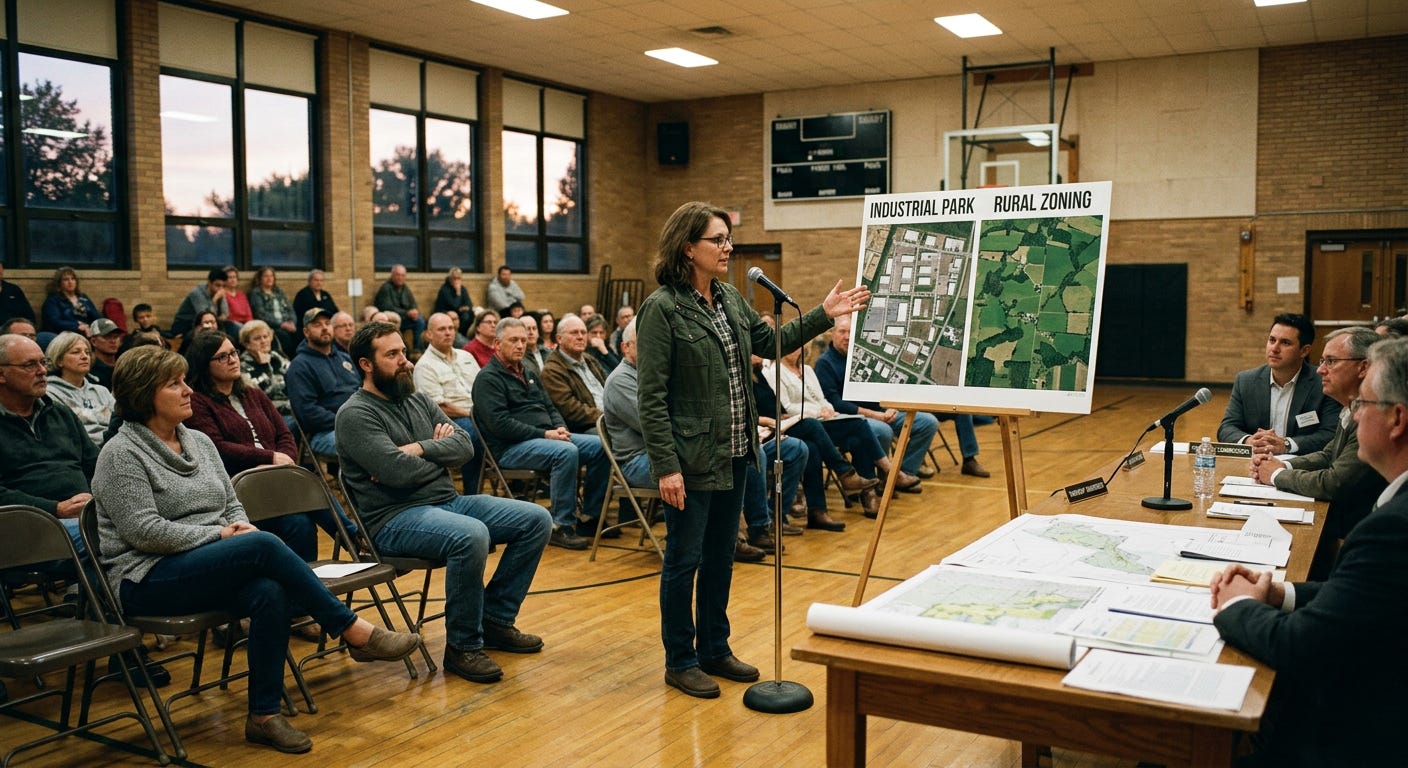
I have sat through enough local meetings to recognize the moment when a room changes. People arrive polite. They sign in, find a folding chair, and wait their turn. Then someone asks the question that has been sitting underneath everything: why here?
That is usually when the mood shifts. Not because people hate progress, jobs, or new technology, but because they begin to suspect the decision was made somewhere else and the public meeting is mostly a formality.
When a big energy or computing project runs into local opposition, the easy explanation is often “NIMBY.” That stands for “Not In My Backyard,” and it is usually used as shorthand for people who support progress in theory but object when the project lands near them.
But that label can be too convenient. It can also be wrong.
In Mayes County, Oklahoma, hundreds of rural residents recently gathered to push back against reported large data center developments. One organizer, Kim Ritchie, put the issue in a single sentence:
“If they were developing it in the Mid-America Industrial Park, I wouldn’t be here.”
— Kim Ritchie, Mayes County resident
That is the sentence developers should tape to the wall.
The residents were not saying, “No data centers, ever.” They were saying something much more practical: industrial-scale projects belong in places prepared for industrial-scale projects. Put them where the roads, utilities, buffers, emergency planning, and public expectations already fit the use.
That distinction matters. It is the difference between rejecting progress and asking for basic respect.
The problem with “no rules”
In many rural counties, there may be little or no formal zoning. To a company looking for land, that can look like a green light. If no ordinance says “stop,” the assumption may be that the project can move forward.
But the absence of rules is not the same thing as public permission.
When residents learn that their local government may not have the tools to evaluate noise, water use, traffic, setbacks, or emergency response, they do not quietly shrug. They organize. They call neighbors. They fill meeting rooms. They pressure state lawmakers. And once trust is lost, it is very hard to win back.
This is where many well-funded projects begin to lose politely. The company may have lawyers, engineers, consultants, and a long list of economic benefits. The community may have folding chairs, handwritten signs, and a deep sense that something is being done to them rather than with them.
In public life, that feeling is powerful. It can turn a project from a land-use matter into a political cause.
Rules can protect both sides
The better path is not endless delay or blanket opposition. It is clear rules before the application arrives.
Louisville, Kentucky, offers one example. After public concern over data centers, planning officials proposed rules that would limit the largest facilities, steer projects toward industrial areas, require separation from sensitive uses such as homes and schools, and address noise, utility costs, and infrastructure impacts.
Harbor Beach, Michigan, offers another. As communities wrestle with large battery storage projects, the city amended its zoning rules to require basic protections up front, including fire planning, stormwater planning, decommissioning plans, and buffers from homes and wetlands.
These rules are not anti-growth. They are guardrails. They tell developers what is expected. They tell residents what is protected. And they replace late-stage anger with a checklist everyone can see.
The Industrial Park Test
So here is a simple test for companies, local officials, and anyone who wants to build big things without burning local trust:
· Can this go in an industrial park? If yes, start there.
· If it cannot, why not? Explain that clearly before buying land or announcing plans.
· What will change for nearby residents? Talk plainly about noise, lights, traffic, water, views, emergency response, and long-term responsibilities.
· What protections are enforceable? Promises are nice. Written standards are better.
That is the Industrial Park Test. It does not ask whether a project is fashionable, futuristic, or profitable. It asks whether the project fits the place.
Communities are not always saying no to change. Often, they are asking for change to arrive with manners.
The irony is that many of these fights are avoidable. A company can be technically right and still lose the room. It can meet the minimum legal requirements and still fail the public test. It can bring money, jobs, and infrastructure and still create the impression that rural people are expected to absorb whatever the market wants to place beside them.
That is how projects lose politely. Not in a dramatic collapse, but in county meetings, neighborhood conversations, statehouse calls, and quiet shifts in public trust.
The way forward is not to sneer at local resistance. It is to listen for the real question underneath it: does this belong here?
Key ideas
· Local opposition is not always anti-progress; often, it is a request for the right project in the right place.
· Industrial-scale projects should start with locations already prepared for industrial use, including roads, utilities, buffers, and emergency planning.
· The absence of zoning or formal rules should not be mistaken for community consent.
· Clear standards protect both residents and developers by making expectations visible before conflict begins.
· The central question is simple: does this project fit this place?
Conclusion
If there is a lesson in these fights, it is that communities are rarely persuaded by being told they are in the way. They are persuaded when someone shows that their place, their routines, their roads, their water, their schools, and their sense of home have been taken seriously.
Big projects may be necessary. Some may even be welcome. But they still have to earn the right to belong somewhere. The Industrial Park Test is not a way to stop everything. It is a way to ask the first honest question before the last public meeting: does this project fit this place, and have the people who live there been treated as more than an obstacle?
If this piece brought a project, meeting, or proposal in your own community to mind, I would be glad to hear the story. Where did officials build trust? Where did the process break down? And what would have helped neighbors feel like they were being invited into the conversation instead of managed around it?
Because the future does not just need somewhere to go. It needs somewhere it can belong.
Source note
This essay draws on local reporting and public materials about recent siting debates involving data centers and battery storage projects, including 2 News Oklahoma’s July 2026 reporting on Mayes County residents organizing against proposed rural data center sites; Louisville Public Media and WLKY coverage of Louisville Metro’s proposed data center regulations; and City of Harbor Beach materials related to its utility-scale battery storage zoning amendment. It also reflects broader public discussions about zoning, infrastructure, utility impacts, emergency planning, and community consent in fast-growing energy and technology projects.
About the author
Peter Hamm is a Master of Christian Leadership candidate at Leland Theological Seminary, a Wilderness First Responder, and an avid outdoor enthusiast shaped by NOLS and Outward Bound. He also writes at Disciple to Faith, The Moral Hinge, and Search Anna Keller.