

The Solar Project That Didn’t Start a Fight
What Sussex County, Delaware can teach clean-energy developers about winning the local land-use fight before it starts.

Across the country, rural clean-energy development has settled into a familiar and depressing script.
A solar or storage project is announced. The developer arrives with glossy presentation boards and a few carefully rehearsed talking points. A Facebook group forms. Neighbors pack a township meeting. The debate stops being about electrons and starts being about identity, property rights, trust, and whether outsiders are trying to pull one over on the community.
Then the project dies.
That is why what happened in Sussex County, Delaware is worth paying attention to.
On July 26, 2026, Delaware Public Media reported that the Sussex County Planning and Zoning Commission recommended approval for six separate solar farm applications. Most were associated with Turning Point Energy, with one filed by Pivot Energy. The projects advanced without reported opposition.
In the world of local energy permitting, that is not a small thing. It is the dog that did not bark.
The lesson is simple, but too often ignored: trust begins with site selection, not public relations.
The land-use argument came first
When renewable projects run into fierce local opposition, developers often tell themselves the community simply does not understand the technology. Sometimes that is true. More often, the first point of friction is not the solar panel. It is the parcel.
People look at a proposal and ask practical questions before they ask ideological ones. Why here? How close is it to my house? Will it change the view? Will it bring traffic? Is this consistent with what the county already said this land is for?
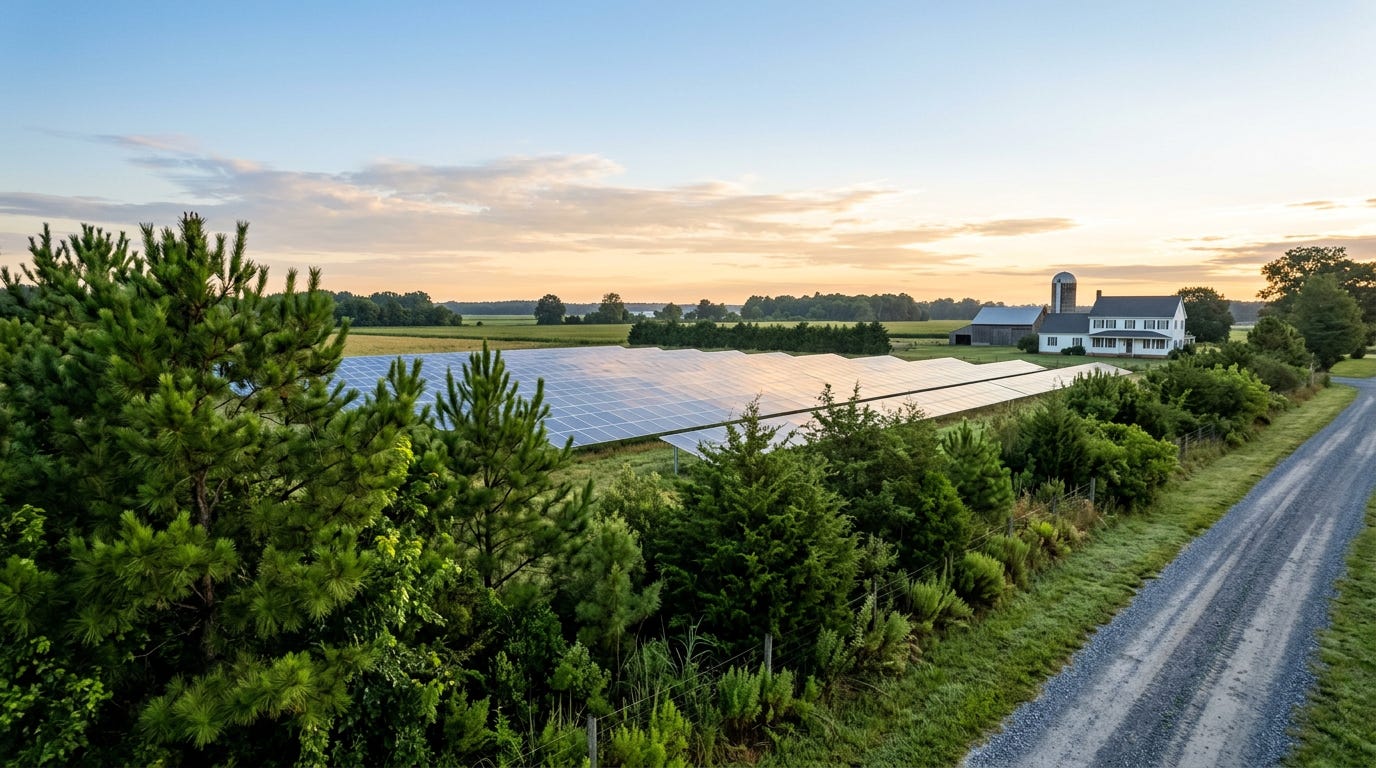
The Sussex County projects appear to have entered the hearing with unusually legible answers. Commissioners pointed to consistency with the county’s comprehensive plan, proximity to existing electrical infrastructure, limited traffic, forested screening, buffers, and fencing.
That matters because local opposition feeds on ambiguity. If residents cannot understand the land-use logic, they will usually fill in the blanks themselves—and rarely in the developer’s favor.
Respect the property line
Most people do not experience energy policy as policy. They experience it from the back porch.
That is why buffers, setbacks, screening, and fencing are not mere engineering details. They are political communication. They tell neighboring landowners that the developer has thought about what the project will look like from their side of the fence.
In Sussex County, the record highlighted forested areas that naturally screen the projects, 30-foot landscape buffers near residential uses, seven-foot fencing, and the absence of a regular on-site workforce. None of that guarantees support. But it does lower the temperature.
Developers sometimes treat these choices as concessions. They should treat them as insurance.
The narrative is built before the hearing
By the time a project reaches a public hearing, the narrative is usually already set. Either the proposal feels compatible with the place, or it feels imposed on the place.
That is the deeper lesson from Sussex County. The quiet hearing was not magic. It was the result of making the right fights less likely: choosing sites that fit existing plans, staying close to existing infrastructure, making impacts easy to understand, and taking neighbors’ physical experience seriously.
· Pick the right parcel. If the site requires a zoning contortion act, opponents will notice.
· Make the impact legible. Talk plainly about traffic, noise, visibility, operations, and maintenance.
· Buffer generously. A setback is cheaper than a lawsuit, a delay, or a dead project.
· Use existing infrastructure whenever possible. A project that connects cleanly to nearby lines feels less disruptive than one that requires a whole new corridor of wires, roads, and construction activity.
· Design for the neighbor’s view, not the developer’s rendering. A site plan may look harmless from above, but the political question is what someone sees from a driveway, field edge, or kitchen window.
· Explain what will not happen. Communities often fear the unknown, so it helps to be clear about what the project will not bring: no constant workforce, no heavy daily truck traffic, no late-night operations, and no open-ended industrial expansion.
· Let the comprehensive plan do some work. When a proposal lines up with a county’s existing planning documents, it is easier to argue that the project belongs there rather than being forced there.
· Start with respect, not persuasion. Engagement after the layout is fixed feels like salesmanship. Good site selection feels like listening.
These choices are not cosmetic. They are the difference between a project that arrives as an argument and one that arrives as a reasonable next step. In local permitting, opponents do not need to prove a project is bad; they only need to make it feel risky, careless, or imposed. Thoughtful siting, clear limits, and visible respect for neighbors make that story much harder to tell.
The bottom line
Local consent is not won by explaining a bad siting decision more elegantly. It is earned by making better siting decisions in the first place.
Sussex County is a reminder that the best public-affairs strategy may be the one that keeps the public fight from happening at all.
Summary
The Sussex County solar approvals offer a useful lesson for clean-energy developers: the easiest public fight to win is the one that never forms. By choosing parcels that fit existing plans, sit near infrastructure, limit visible impacts, and respect neighboring property owners, developers can reduce distrust before a hearing ever begins. The point is not that every renewable project will avoid opposition. It is that trust is often built through practical land-use decisions long before anyone starts making the case for clean energy.
Call to action
If you work in clean energy, local government, land use, or community advocacy, I would like to hear from you: what makes a project feel like it belongs in a place, and what makes it feel imposed? Reply with examples from your community, share this with someone working on siting or permitting, and subscribe to Politley Losing for more writing on how public decisions are won, lost, and misunderstood.
Sources: Delaware Public Media reporting on the Sussex County Planning and Zoning Commission’s July 2026 solar recommendations; Sussex County comprehensive-plan references cited in the public proceedings; broader renewable-siting and interconnection context from public land-use and energy-sector research.