

The New Local Backlash to Data Centers and Battery Storage
Why communities are using “paired moratoriums” to slow fast-moving infrastructure before the rules catch up

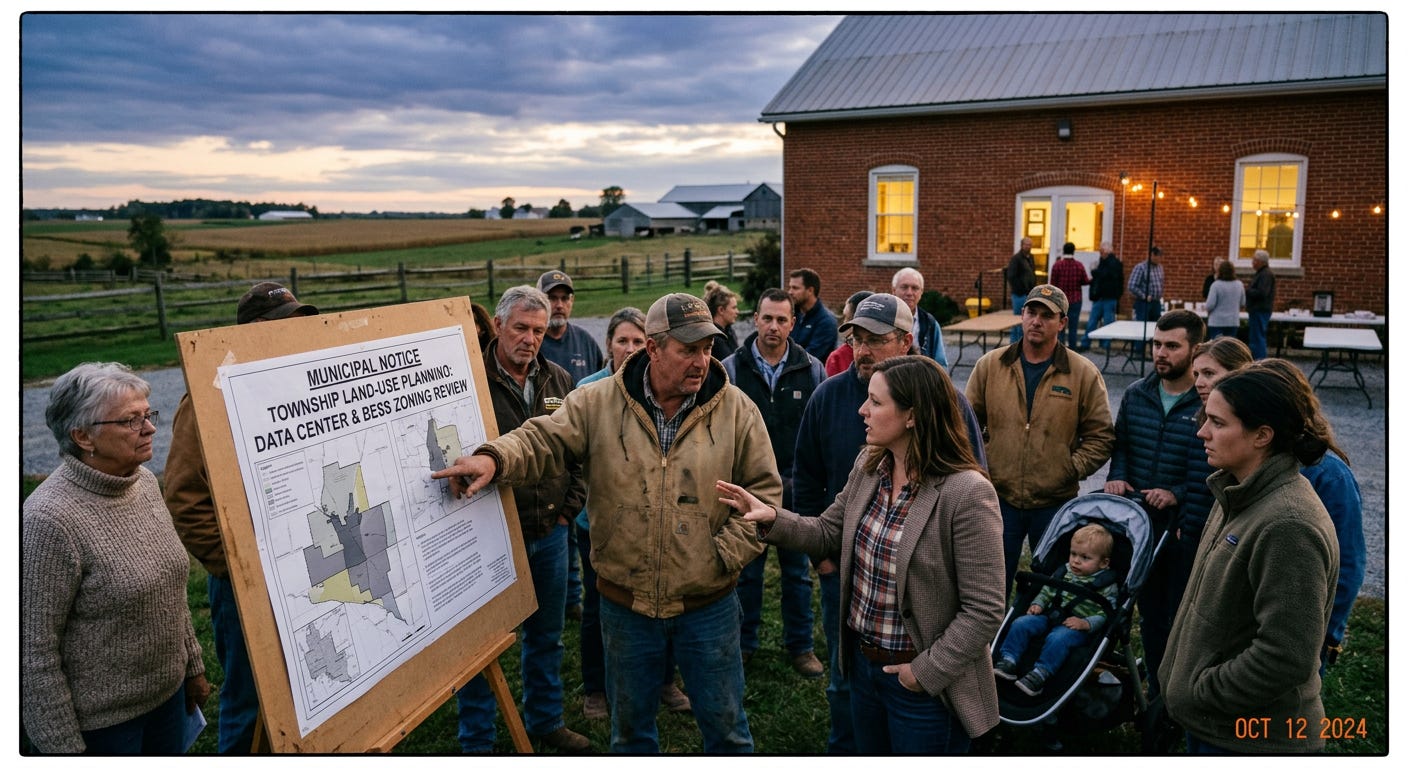
Local governments are beginning to treat two very different technologies as one land-use problem.
On paper, a hyperscale AI data center and a battery energy storage system, or BESS, are not the same thing. One is a computing campus with enormous power and cooling demands. The other is a grid-balancing facility designed to store and dispatch electricity.
But from the perspective of a rural township board, a planning commission, or a neighborhood that just learned about a major project through rumors, the distinction can collapse quickly.
Both can look like large, externally driven industrial facilities arriving before local rules exist to govern them. That is the political opening for what I call the paired moratorium: a temporary pause that bundles data centers and battery storage into one regulatory timeout.
What Triggers a Paired Moratorium?
1. Unzoned land or code gap: A rumor, land option, utility inquiry, or early site-control move alerts residents before formal rules are in place.
2. Local response: Officials adopt a temporary pause covering both data centers and BESS facilities.
3. End goal: The jurisdiction uses the pause to draft local standards before applications arrive.
The Wave of Paired Pauses
Recent local actions show how quickly this pattern is spreading:
· Hillsboro, Oregon: On July 27, 2026, the City Council enacted a 120-day land-use moratorium on new or expanded data centers and standalone BESS facilities proposed as a primary use. The city said the pause would give officials time to evaluate how these facilities fit into long-term land-use planning and potential Community Development Code updates. [1]
· Kalamazoo Township and nearby Michigan communities: Kalamazoo Township advanced ordinances toward a yearlong pause on data centers and BESS facilities while it studies impacts and drafts standards. Regional reporting shows similar moves across southwest Michigan, including Portage and Oshtemo, as communities weigh infrastructure, safety, and environmental concerns. [2]
· Orangetown, New York: The town scheduled a public hearing on a proposed 180-day moratorium covering both battery energy storage systems and data storage facilities while officials consider siting, noise, fire, energy-use, and health-and-safety standards. [3]
These pauses are not necessarily permanent rejections. In places like Harbor Beach, Michigan, officials moved from a pause-and-study posture toward dedicated zoning rules for utility-scale battery storage, including application materials for decommissioning, land restoration, fire protection, stormwater management, lighting, noise, and setbacks. [4]
In other words: a moratorium has become the default planning tool when technology outpaces the local zoning code.
Why Communities Bundle Digital and Energy Infrastructure
Why are local boards placing computing campuses and grid batteries in the same political category? Because from the public’s perspective, both technologies share several high-friction characteristics:
Large Industrial Footprints: Both require substantial acreage, significant electrical interconnections, and visible industrial equipment—often placed adjacent to farmland or residential districts.
Limited Institutional Experience: Most small-town planning boards lack dedicated staff or technical consultants trained to evaluate thermal runaway risks, noise contours, or localized grid impacts.
High Resource Demands & Safety Questions: Residents voice parallel concerns about water drawdowns, air permitting, emergency response preparation, noise, and long-term site abandonment.
The Threat of “Institutional Surprise”: In many communities, opposition begins before a formal application is even filed. A land option, a utility power inquiry, or a rumor is enough to create uncertainty. Uncertainty itself has become the mobilizing event.
Once residents realize their local code lacks explicit guardrails, they rarely wait for the developer’s formal presentation. They ask for a pause so the community can regain control of the timeline.
What Developers and Advocates Should Learn
The spread of paired moratoriums carries a clear lesson: the absence of a filed application is not the absence of community concern.
Relying on a “no zoning” loophole or assuming that quiet land acquisition will shield a project almost always backfires. By the time a developer officially introduces the project, neighbors may already believe the decision was made privately. That turns a routine land-use matter into a political crusade.
For project sponsors, energy leaders, and advocates, the field playbook needs to change:
Stop Treating Zoning Gaps as Permission: If a host jurisdiction lacks an updated ordinance for storage or computing, do not treat the vacuum as a green light. Expect a moratorium to fill the void unless proactive engagement begins early.
Support Independent Local Standard-Setting: Providing model ordinances can be helpful, but communities only trust rules developed through an independent, locally controlled process. Fund third-party technical assistance so township boards can hire their own experts.
Answer Operational Safety Early: Technical assurances about “low probability events” do not satisfy local fire chiefs or neighbors. Clear plans for emergency response, water monitoring, setbacks, and fully funded decommissioning bonds must precede site announcements.
Communities are not necessarily rejecting technology outright. They are demanding that major change arrive with clear rules, fair notice, and local consent.
Summary
A paired moratorium is not just a procedural delay. It is a warning signal. Communities increasingly see data centers and battery storage as part of the same land-use challenge: fast-moving infrastructure arriving before local governments have clear standards for scale, safety, resource use, emergency response, and long-term accountability.
For developers, the lesson is simple: do not mistake silence for consent, and do not treat outdated zoning as permission. The communities that move fastest against a project are often the ones that feel they were asked to react after the real decisions had already been made.
Call to Action
If you are working on data center, energy storage, utility, or land-use strategy, start the conversation before the application is filed. Use these questions to pressure-test whether the project is ready for public scrutiny:
· Has the host community adopted clear rules for data centers, battery storage, or both?
· If the local code is silent, who is helping the community write standards before the application is filed?
· Has the developer met with elected officials, planning staff, emergency responders, and affected neighbors before announcing the site?
· Can the project explain its water use, power demand, noise profile, traffic impacts, setbacks, fire response plan, and decommissioning funding in plain language?
· Will local fire, planning, and environmental officials have independent technical advice—not just information supplied by the project team?
· What happens if residents first learn about the project through rumors, land records, or a utility interconnection filing?
· Is there a credible plan for public meetings, community questions, written responses, and design changes before opposition hardens?
· Who owns the long-term obligations if the project changes hands, fails, or is abandoned?
Want to avoid becoming the next moratorium headline? Share this with your siting, permitting, communications, or government affairs team—and pressure-test your local engagement plan before the rumor mill writes the story for you.
Citations
About the Author
Peter Hamm is the founder and editor of Politely Losing. His career spans more than 30 years across government operations, defense-sector network management, and executive distribution leadership in the insurance industry. Having served as Chief Clerk for the U.S. House Committee on Rules and managed complex field operations across distributed regions, Peter brings a pragmatic, battle-tested perspective to how public policy, land use, and organizational strategy intersect on the ground.
As an author, analyst, and media producer based in the Mid-Atlantic, Peter focuses on the human and institutional dynamics behind infrastructure development—exploring why viable clean energy, data center, and regional projects fail, and how developers, local leaders, and land advocates can build genuine, durable local trust.
Connect & Follow Substack: Politely Losing & The Moral Hinge
Field Reports: Coming soon to Spotify, Apple Podcasts, and video platforms.
Get in Touch: Hit Reply on any newsletter edition or leave a comment to share local ordinance updates, field tips, or project case studies from your region.