

The First Letter Is the First Test
A survey notice may satisfy the law, but it can still fail the trust test.

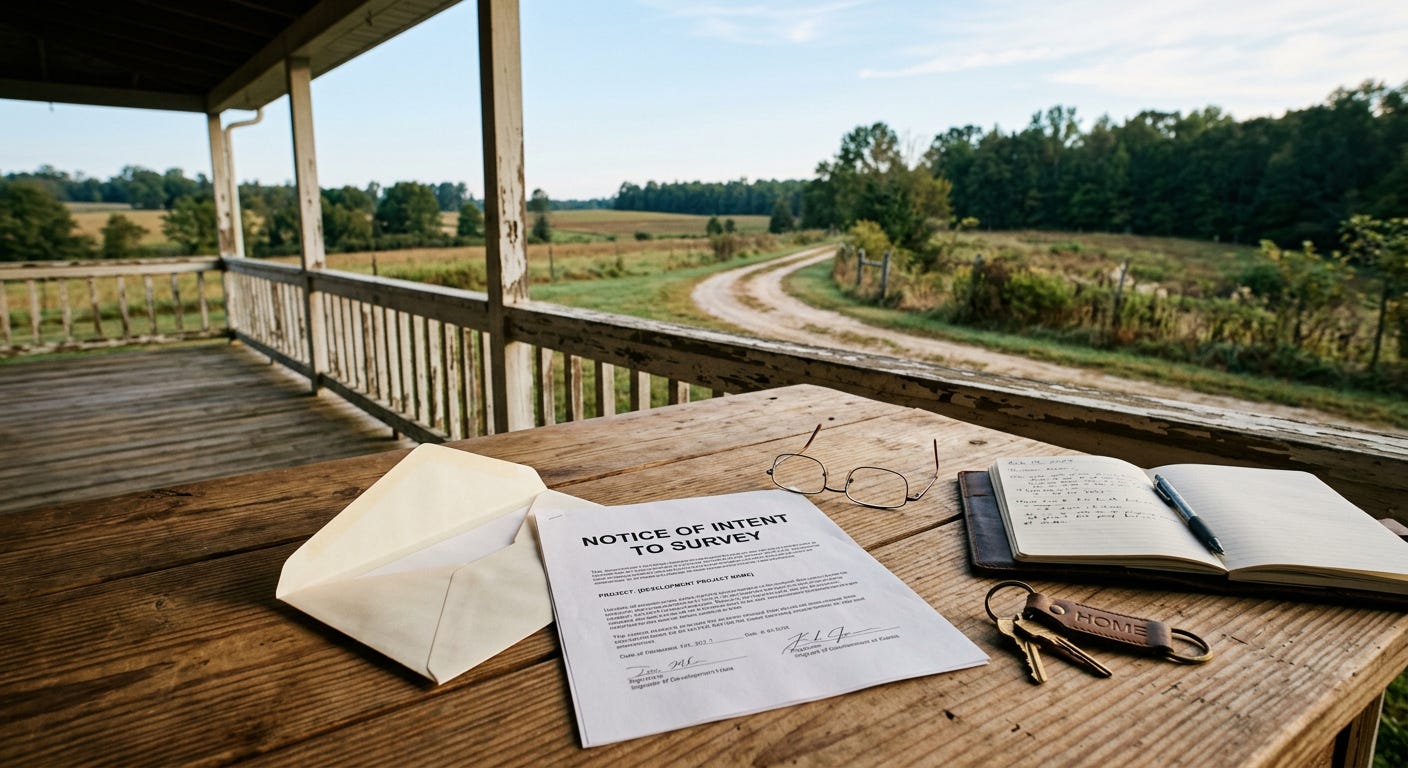
There is a moment in almost every linear infrastructure project when the technical process collides with the public narrative.
1. Engineers identify a preliminary corridor.
2. The company mails certified survey access notices to affected property owners.
3. Field crews begin mapping terrain, soils, wetlands, and rights-of-way.
4. The company holds a formal public meeting once the preliminary design is ready.
On paper, the sequence looks efficient. It checks the legal boxes, protects the project schedule, and gives engineers the data they need. In the real world, it is often the exact moment a project risks eroding trust.
When a rural landowner opens a mailbox and finds a formal letter declaring that a utility intends to access private property for a high-voltage power line they have never heard about, they do not read it as a routine administrative step. They may experience it as abrupt, impersonal, and intrusive.
The McClellanville case: when the first message is the wrong message
The active dispute around the McClellanville 115-kV transmission project in South Carolina shows how quickly this dynamic can harden. Central Electric Power Cooperative has proposed a new transmission line to improve electric service in the McClellanville area, with federal environmental review materials describing alternatives across Berkeley, Charleston, and Georgetown counties.
Local reporting has described landowners denying survey access after receiving requests to allow crews onto their property. The telling quote was not, “We oppose reliable electricity.” It was, “We had no idea this was going on prior to that.”
For readers who want to review the underlying project record, see the USDA Rural Development project page, the Federal Register notice for the Final Environmental Impact Statement, the federal permitting dashboard entry, and the 2025 Record of Decision.
• USDA Rural Development project page
• Federal Register Final EIS notice
• Federal Permitting Dashboard entry
• USDA Rural Development Record of Decision
• Private lands supplemental routing report
That is the narrative break. Once residents discover a project through a statutory access request instead of a direct, human-scale conversation, the story is no longer only about reliability, need, alternatives, or route design. It also becomes about process, trust, and whether affected property owners feel meaningfully informed.
• The utility’s view: We are fulfilling a statutory requirement to collect objective environmental and engineering data before finalizing a route.
• The landowner’s view: The utility may already have narrowed the options, and my property may be affected before I have had a meaningful chance to understand the process.
By the time the first open house arrives, the project team may think it is beginning public engagement. The community may believe it is already defending itself.
The legal fallacy: compliance is not consent
Legal and regulatory teams often insist that survey notices must be precise, certified, and rights-preserving. They are not wrong. But there is a difference between meeting a statutory obligation and earning the practical cooperation required to carry out the work.
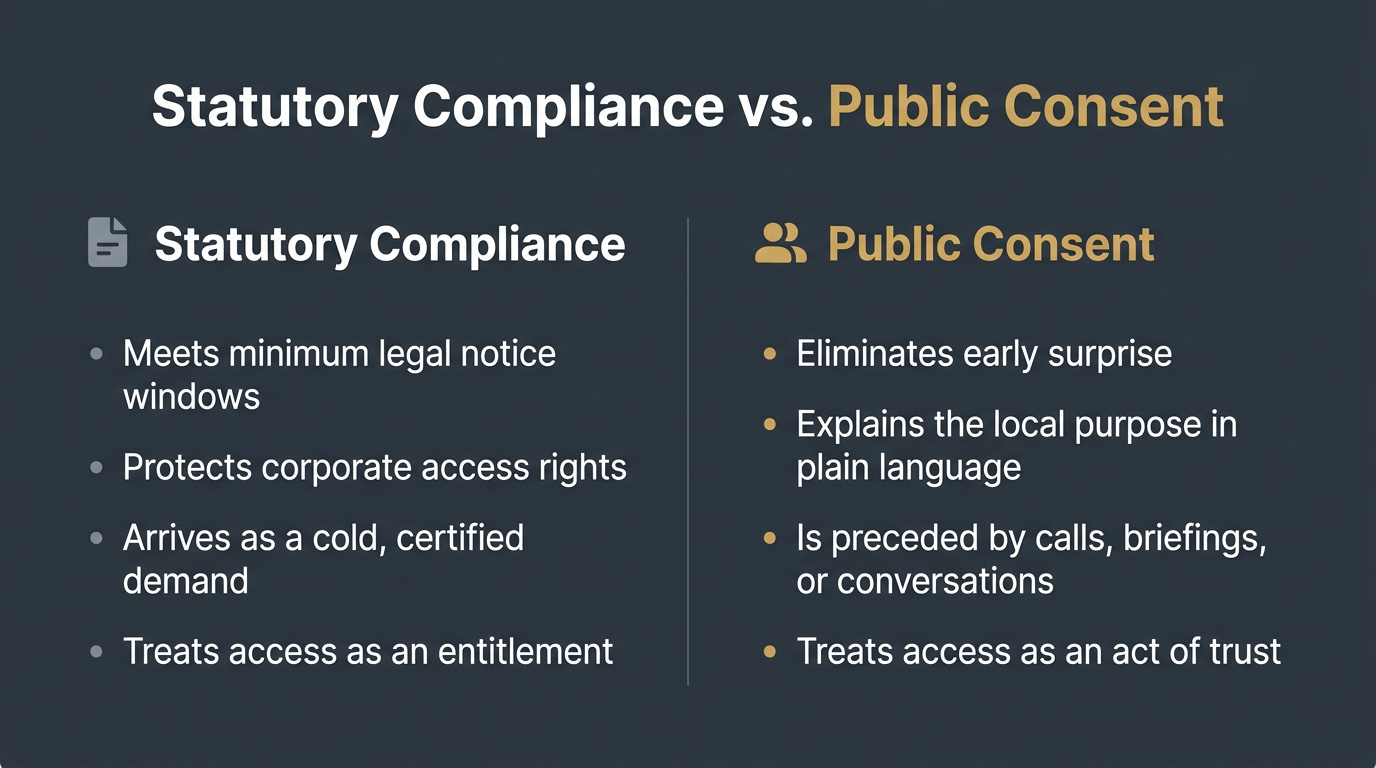
When developers treat statutory minimums as the outreach strategy, they trade short-term administrative efficiency for long-term resistance. That resistance can show up as denied access, organized petitions, elected-official pressure, permit delays, and right-of-way litigation.
A better playbook: the pre-notice engagement protocol
If infrastructure providers want voluntary survey permissions, safer field work, and fewer early-stage escalations, they need to rethink the “first letter.” The notice should not be the first time a landowner learns the project exists.
1. Brief local leadership first. Before letters hit mailboxes, brief county commissioners, planning staff, town officials, and credible community leaders. They should not learn about the project from a frightened constituent holding a survey notice.
2. Send a no-surprises context letter. Pair the legal notice with a plain-language explanation of why the study area is being evaluated, what survey crews will and will not do, how property impacts will be handled, and what decisions have not yet been made.
3. Provide a real human contact. Replace generic hotlines and PO boxes with the direct phone number and email address of a named land agent who can discuss gates, crops, livestock, timing, property damage, and access preferences.
4. Host small-group landowner briefings. Invite directly affected parcel owners to informal meetings before crews arrive. The goal is not to “sell” the project. The goal is to let people ask practical questions before fear fills the information vacuum.
The bottom line
A survey notice is not merely an administrative task. It is the project’s opening handshake.
If the first interaction with a private landowner is a legal notice asserting access rights, do not be surprised when the next interaction is concern, organized opposition, or a request for legal advice. A legally complete notice is not a trust strategy.
Call to action
If you work in infrastructure, utilities, permitting, right-of-way, or public affairs, review your survey notice process before the next corridor study begins. Ask a practical question: would a landowner experience our first communication as a clear explanation of what is being studied, what has not yet been decided, and whom to contact with concerns?
Better communication will not eliminate every disagreement over siting, access, or land use. It can, however, give residents the information they need to participate constructively and give project teams a better chance to earn cooperation before positions harden.
About Politely Losing
Politely Losing makes the case that infrastructure can be built quickly, profitably, and honestly — and that developers who skip the third one usually end up losing on the first two anyway.
At its core, Politely Losing argues that public trust is not a soft add-on to infrastructure development; it is a practical condition for speed, certainty, and durable outcomes. The developers who explain early, listen honestly, and treat communities as participants rather than obstacles are usually the ones best positioned to move projects forward without turning every step into a fight.