

Texas’s $33 Billion Lesson: Grid Need Is Not Social License
The Permian Basin transmission fight shows why infrastructure projects cannot treat technical necessity as public consent.

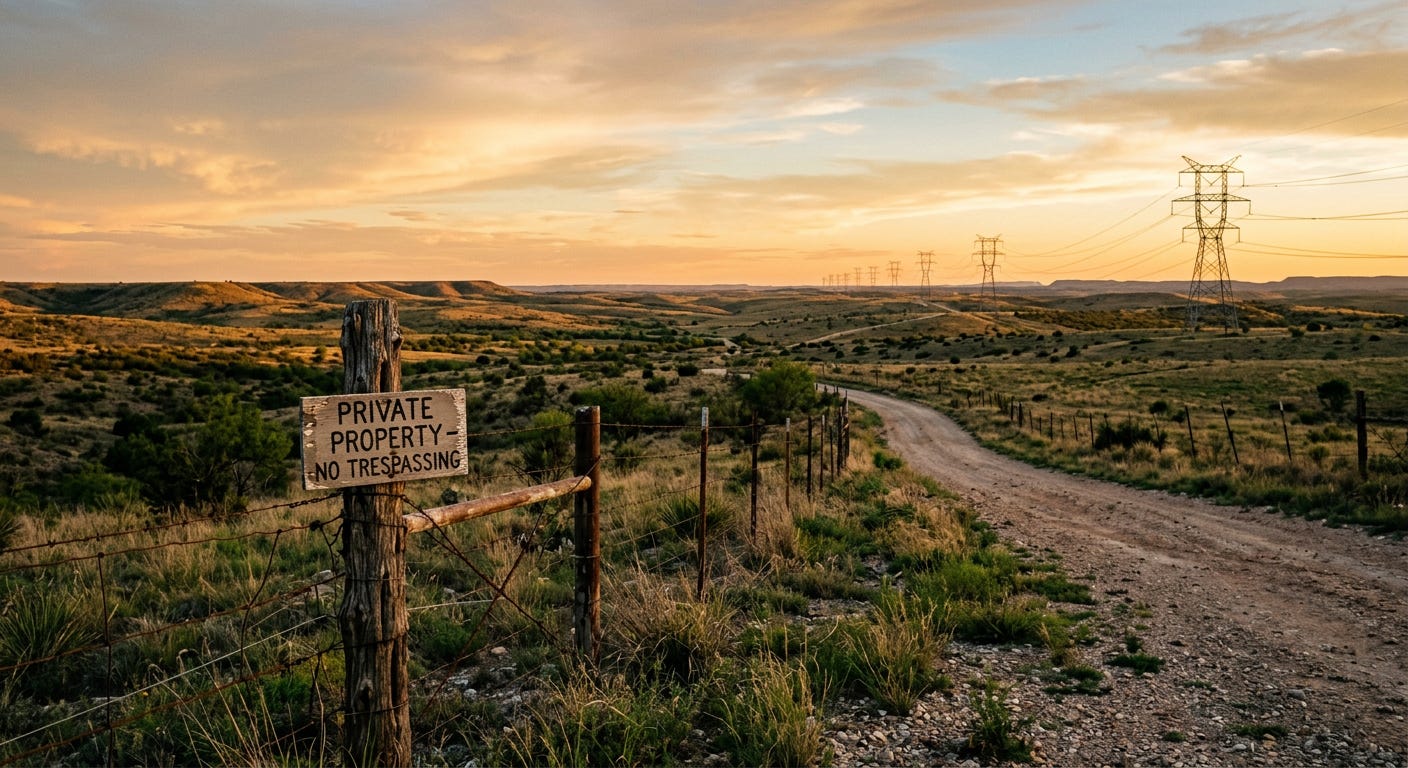
Texas does not have a power-line problem so much as it has a trust problem wrapped around a power-line problem.
The need for more transmission in the Permian Basin is not hard to explain. Oil and gas production, electrification of field operations, population growth, industrial load, data centers, and ordinary household demand are all pressing against a grid that was not built for this scale or speed of growth. Reasonable people can look at that load forecast and agree that West Texas needs more capacity.
But agreement on need is not the same as agreement on method. The Public Utility Commission of Texas adopted the Permian Basin Reliability Plan to address rising demand, reduce congestion, and improve reliability. The plan includes local transmission upgrades and large extra-high-voltage import paths designed to move power into the region at a much larger scale.
That is where an engineering challenge became a civic one. By the summer of 2026, the plan had become a political test of whether Texas can build essential infrastructure while respecting private property, local trust, and procedural fairness.
The flashpoint is a proposed 765-kilovolt transmission buildout: towering lines, broad rights-of-way, and routes crossing farms, ranches, schools, rural communities, and family land. At a marathon Texas Senate hearing in July 2026, landowners testified for hours about inadequate notice, shifting routes, compressed deadlines, and the feeling that their properties had become variables in a statewide engineering problem. Texas Lieutenant Governor Dan Patrick summarized the rupture bluntly: the lines may be needed, but they should not come at the expense of private property rights.
The Four-Conversation Mistake
The Politely Losing view is not that one side is right and the other is wrong. It is that both sides are often asking legitimate questions in different languages. Grid planners ask, “How do we keep the lights on?” Landowners ask, “Why is my land the answer?” A healthy process has to make room for both questions before either side hardens into a slogan.
The mistake starts when developers, utilities, and public agencies collapse four distinct conversations into one.
System Need: Does the grid actually require more capacity?
2. Technology Choice: Are 765-kV lines the right technical answer?
Corridor Selection: Which broad geographical path should the power follow?
Parcel-Level Impact: Whose back pasture, timber stand, or family ranch gets cut in half by an easement?
When those four conversations are blurred together, people stop hearing each other. In Texas, many project proponents appeared to assume that because the public-policy case for Step 1 was strong, the remaining steps would follow naturally. If the grid needs power, then the technical solution must be acceptable. If the technical solution is acceptable, then the corridors must be acceptable. If the corridors are acceptable, then the parcel-level impacts must be tolerable.
That is not how consent works, and it is not how durable public decisions are built. Support for a system objective does not automatically transfer to support for a specific technology, a specific corridor, or a specific easement across someone’s family land. Landowners can accept the need for reliability and still reject a process that gives them too little notice, too little agency, and too little confidence that alternatives were seriously considered.
Corridor Consent Is Not Transitive
That is why corridor consent is not transitive. The assumption is especially dangerous for linear infrastructure. A power plant, a substation, a battery project, or a factory may concentrate impacts in one location. A transmission line spreads impact across hundreds of miles, touching people who may never directly benefit from the project and who may experience the public good only as a private burden.
This does not make opponents anti-grid, anti-growth, or anti-progress. It makes them people who are being asked to host part of the solution. When residents believe the route was effectively chosen before they were properly notified, technical arguments about voltage, peak load, and congestion no longer persuade. Opponents do not have to prove the lines are unnecessary. They only have to prove the process was unfair, rushed, or imposed.
Imagine a ranch family that has spent decades improving a back pasture: fencing it, managing the grass, planning where the next generation might build, and thinking of the land less as an asset than as a family obligation. On the project map, that pasture may appear as a clean line between two substations. In the family’s life, it is where cattle move, where children learned to drive a truck, where a future home site may sit, and where an easement could change daily operations for generations. That does not automatically make the line wrong. It does mean the explanation has to be better than, “The model says this is the route.”
The Political Risk of Treating Process as Paperwork
That is why process cannot be treated as paperwork. Notice letters, routing meetings, hearing deadlines, intervention rights, alternatives analysis, and maps look administrative from the project side. From the landowner side, they are the only visible evidence that the project sponsor recognizes the difference between a public need and a private burden.
That distinction is everything. If the public process appears rushed, every subsequent claim becomes harder to believe. If the route changes without clear explanation, people assume manipulation. If landowners need lawyers to understand basic participation rights, the project has already created a credibility problem. Once credibility is lost, the question stops being, “Is this the best transmission solution?” and becomes, “Who is being asked to pay for it with their land?”
A Better Way to Build Necessary Infrastructure
A better process begins by refusing the easy caricature. Reliability advocates are not villains for worrying about load growth. Landowners are not obstructionists for defending their property. The public interest is not served by forcing either side to pretend the other has no valid concern. It is served by creating a transparent forum where the need, the alternatives, the route, and the burden can be discussed honestly while choices are still genuinely open.
· Start with need, but do not stop there. Explain the load forecast, reliability risk, and alternatives in plain language before discussing routes.
· Separate corridor planning from parcel routing. Give communities a chance to debate broad corridors before individual landowners are forced into defensive legal posture.
· Publish alternatives early. Show what was rejected, why it was rejected, and what tradeoffs were considered.
· Give landowners usable notice. Notice should be timely, understandable, geographically precise, and paired with clear instructions for participation.
· Design for dignity. Treat hosts as partners in solving a statewide problem, not obstacles to be managed after the engineering work is done.
Why This Matters Beyond Texas
This is not just a Texas transmission story. The same pattern appears wherever public-interest projects collide with private burdens: pipelines, renewable energy projects, broadband corridors, data centers, housing, roads, water systems, and industrial development. The facts change, but the civic test is familiar. One side points to urgency, scale, and public need. The other points to notice, fairness, local impact, and trust. Politely Losing exists in that space, because durable decisions are rarely built by declaring one side virtuous and the other unreasonable. They are built when the people asking for sacrifice are willing to show their work, and the people being asked to sacrifice are given a real chance to shape the answer.
The Takeaway
The Politely Losing answer is not to pick a winner. It is to insist on a better table. Reliability and property rights are not opposing objectives. They are both conditions of durable infrastructure. A transmission system that cannot secure legitimate, trusted corridors is ultimately a grid that cannot be built at the pace reliability requires.
The lesson from Texas is not that large-scale infrastructure is impossible. It is that grid need is not social license, and social license cannot be retrofitted onto a map after the lines are drawn. If agencies, utilities, landowners, and communities want decisions that last, they have to meet before the positions harden: early, locally, transparently, and before the decisions become irreversible.
Summary
Texas’s Permian Basin transmission fight shows that infrastructure need and public consent are not the same thing. The grid may genuinely need more capacity, and landowners may genuinely deserve a more transparent process. The hard work is not choosing which truth to honor. The hard work is building a table honest enough to hold both.
Call to Action
If you work on infrastructure, energy, land use, or public policy, do not wait until the map is final to ask who has been heard. Subscribe to Politely Losing, share this piece with someone working on a hard public-interest project, and bring one question to the next meeting: what would it take for both sides to believe this process was honest, transparent, and worthy of trust, even if nobody gets everything they want?