

State Approval Won’t Save a Project Built on a Broken Local Record
Bypassing county zoning may look like a shortcut for utility-scale renewables. In practice, it often turns local friction into legal gridlock.

Summary
State-level siting approval can help renewable energy projects move forward, but it cannot replace the legitimacy built through a strong local record. Recent disputes in Michigan and Iowa show that when developers bypass county zoning too quickly, they may gain a state forum while also creating litigation risk, hardening community opposition, and giving opponents a clearer procedural argument. The better strategy is to engage locally first, propose project-specific safeguards, and treat state preemption as a backstop rather than the opening move.
· State approval is not a substitute for local legitimacy. A project can win at the commission level and still face serious local resistance.
· Skipping county process creates procedural risk. Opponents can argue that the project failed to build the record required before seeking state relief.
· Community concerns harden when people feel bypassed. Setbacks, drainage, screening, road use, and decommissioning should be addressed before the fight escalates.
· The best strategy is local-first. Developers should exhaust county pathways, offer project-specific safeguards, and use state preemption only as a backstop.
Utility-scale renewable energy projects are running into a harder local politics than many developers expected. In response, state legislatures and utility commissions have increasingly offered a tempting workaround: state-level siting approval.
On paper, the logic is straightforward. If a county board will not approve a wind, solar, or storage project, the developer can move the fight to a state forum designed to streamline infrastructure decisions. In Michigan, Public Act 233 created a siting process at the Michigan Public Service Commission for utility-scale wind, solar, and energy storage projects under certain circumstances, and Michigan guidance explains that the law gives the Commission permitting authority unless a local government has adopted a compatible renewable energy ordinance.1
For developers staring down interconnection deadlines and capital commitments, that can feel like a silver bullet. But the political and legal reality is less forgiving: state preemption may move the approval venue, but it does not manufacture local legitimacy.
The Preemption Trap
Two current disputes show why the “just go to the state” strategy can backfire.
1. Wexford County, Michigan: The preemption pivot
In Wexford County, the local planning process became a flashpoint when officials and residents objected to zoning changes tied to a proposed large solar project. The key issue was not merely whether solar belongs in the county. It was whether broad zoning changes would open agricultural land to industrial-scale use without enough project-specific guardrails.
Under Michigan’s new siting framework, a developer may have a path to the Michigan Public Service Commission. But the moment a project pivots from county deliberation to state override, the story changes. What might have been framed as landowner opportunity and tax base growth becomes a fight over who gets to decide the future of the county.
2. Cerro Gordo County, Iowa: The courtroom escalation
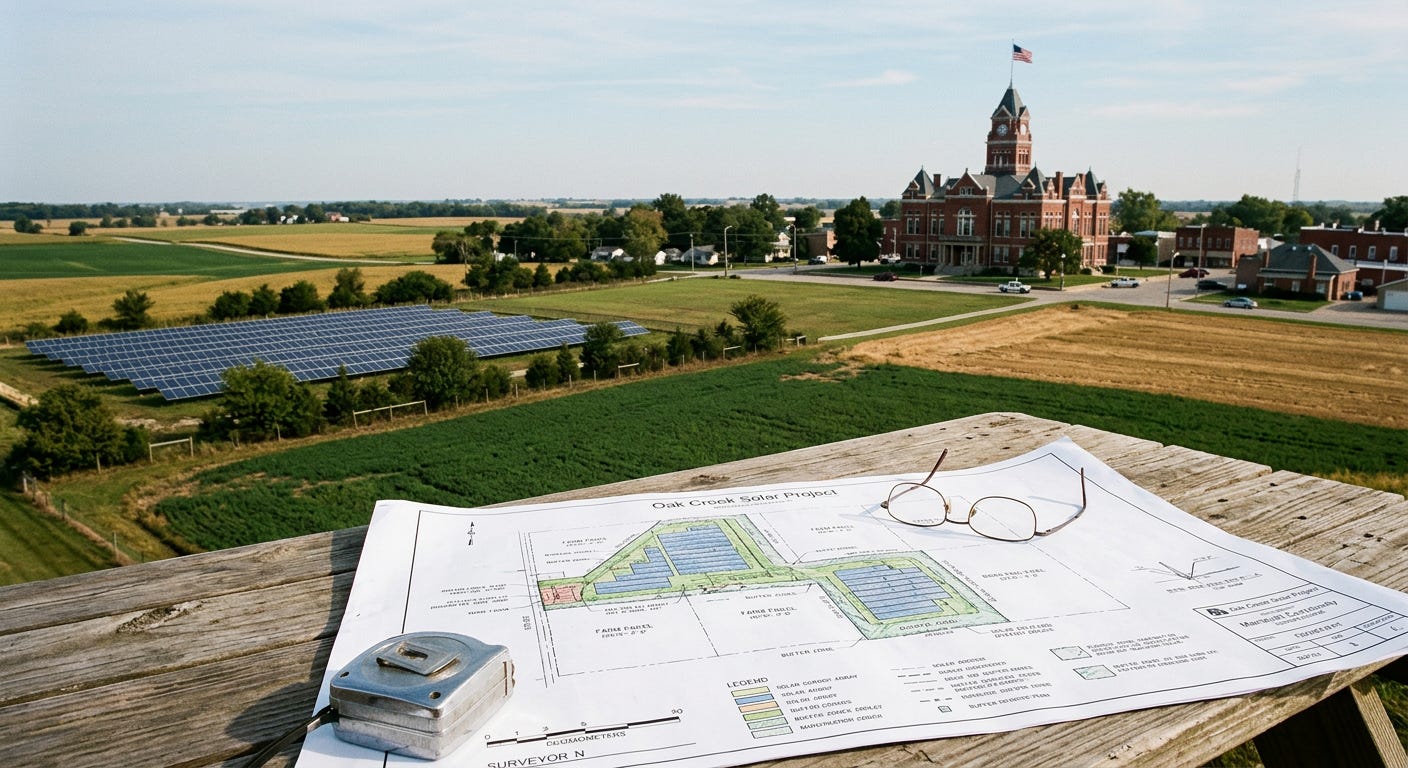
In Iowa, that escalation is already happening. Cerro Gordo County has filed for judicial review after the Iowa Utilities Commission approved a 500-megawatt solar generating facility proposed by River City Energy. Local reporting says the project would cover roughly 3,000 acres, and the county argues the developer did not first apply for a county zoning permit or seek rezoning before going to the state.2
That distinction matters. The county is not simply arguing “no solar here.” According to local coverage, Cerro Gordo County says utility-scale generating facilities are allowed in industrial and commercial districts and that applicants can seek rezoning. Its argument is procedural: the state allegedly allowed the project to leapfrog the local pathway instead of requiring the developer to build a record there first.2
Why the Shortcut Becomes the Long Way Around
When developers treat state preemption as the main siting strategy instead of a last-resort backstop, three predictable risks emerge.
· Litigation risk rises. A state certificate issued over an incomplete or hostile local record invites county-led lawsuits, administrative appeals, and injunction requests. A process meant to save months can become years of litigation.
· Community opposition hardens. Residents who might have accepted a project with setbacks, screening, drainage protections, and decommissioning guarantees often dig in when they believe local self-government has been ignored.
· The ownership narrative changes. Developers may frame siting as a matter of landowners choosing how to use their property. But where outside corporate owners, tenant farming relationships, or large land aggregations are involved, a state override can reinforce the perception that local land policy is being dictated from elsewhere.
The Better Playbook: Local Legitimacy First
State preemption should be a safety net, not the opening move. Infrastructure leaders who want projects that can actually be built should do three things before asking a state agency to rescue them.
1. Offer project-specific rules, not blanket zoning changes. County boards are often more willing to consider narrow conditional-use terms, acreage limits, and enforceable site plans than broad amendments that appear to industrialize entire agricultural districts.
2. Exhaust local pathways first. Even in preemption states, applying locally builds an auditable record of good-faith engagement. That record matters if the dispute later moves to a state commission or court.
3. Put plain-spoken siting standards on the table early. Setbacks, vegetative screening, stormwater and drainage protections, agricultural mitigation, road-use agreements, and decommissioning security should be discussed before—not after—the vote.
The lesson from Iowa and Michigan is simple: bypassing the county courthouse does not eliminate local resistance. It just changes the battlefield—and often gives opponents a cleaner procedural argument.
Potential Challenges
Even a local-first strategy does not guarantee an easy path. Developers, county officials, landowners, and opponents still have to navigate several practical challenges that can derail a project or distort the public debate. Federal and national-lab research emphasizes that large-scale renewable siting can involve multiple levels of government, public involvement requirements, local land-use standards, interconnection and transmission constraints, environmental considerations, and host-community priorities.3
· Timing pressure can push parties toward shortcuts. Interconnection queues, tax-credit deadlines, financing milestones, and equipment commitments can make slow local deliberation feel impossible; Berkeley Lab’s developer survey found that about half of wind and solar projects experience delays of six months or more, with permitting, grid interconnection, local ordinances or zoning, and community opposition among the leading causes of delay or cancellation.4
· Local standards may be outdated or unclear. Many county ordinances were not written with modern utility-scale solar, wind, or battery storage in mind, leaving boards to improvise under public pressure; DOE and Berkeley Lab’s national inventory shows that siting authority, standards, timelines, and public-involvement requirements vary widely across states and often depend on project size.3
· Information gaps can fuel mistrust. Residents may not have clear answers on drainage, fire response, glare, setbacks, road damage, property values, or decommissioning until late in the process; DOE notes that siting decisions shape benefits and burdens for local communities, ecosystems, and agricultural areas and that host communities frequently have questions about those impacts.5
· State preemption can polarize the room. Once a project appears headed to a state commission, local debate may shift from project design to local control, making compromise harder; research on developer engagement found that communities are often notified only after site control has been secured, limiting how much a project can still change in response to public feedback.6
· Legal uncertainty can chill investment. Counties, developers, and financiers may all hesitate when it is unclear whether state approval, local zoning, or a court ruling will ultimately control the project’s fate; the Sabin Center has tracked hundreds of contested renewable projects and reports that local restrictions and lawsuits targeting renewable facilities have become more prevalent across the United States.7
Conclusion
Renewable energy projects do not fail only because opponents dislike wind turbines, solar panels, or battery storage. They often fail because the process makes communities feel like decisions have already been made somewhere else. State-level approval can resolve a permitting impasse, but it cannot repair a weak local record after trust has already collapsed. The projects most likely to survive legal, political, and reputational pressure are the ones that treat county process as part of the infrastructure—not as an obstacle to route around.
Call to Action
If you are developing, advising, investing in, regulating, or opposing utility-scale renewable projects, do not wait until the room is already divided. Start with the county record. Ask whether the local process has been exhausted, whether residents can see enforceable protections in writing, and whether the project could survive public scrutiny before it ever reaches a state commission.
If this analysis sharpened how you think about renewable siting, subscribe to Politely Losing, share this article with a county official, developer, landowner, attorney, or energy investor who needs to hear it, and send me the local siting fight I should examine next.
Sources
1. State of Michigan, “Renewable Energy and Storage Facility Siting,” explaining that Public Act 233 of 2023 establishes a Commission siting process for utility-scale wind, solar, and energy storage facilities under certain circumstances; University of Michigan Graham Sustainability Institute, “Michigan’s New Renewable Energy Siting Law,” explaining that the law grants permitting authority to the Michigan Public Service Commission unless local governments adopt compatible renewable energy ordinances.
2. ABC 6 News / KAALTV, “Cerro Gordo County files lawsuit against Iowa Utilities Commission over solar farm development,” reporting that Cerro Gordo County filed for judicial review after approval of a proposed 500-megawatt River City Energy solar facility and describing the county’s zoning and procedural arguments.
3. U.S. Department of Energy, “Siting of Large-Scale Renewable Energy Projects,” and Lawrence Berkeley National Laboratory / DOE, “Siting Clean Energy: An Inventory of State Policies and Permitting Authorities,” describing the complexity of renewable siting, including multiple levels of government, public involvement requirements, varying siting standards, and the role of local authority.
4. Lawrence Berkeley National Laboratory, “Large-scale wind and solar developers concerned about social factors affecting deployment,” summarizing survey findings that roughly one-third of siting applications were canceled, about half experienced delays of six months or more, and local ordinances or zoning, grid interconnection, and community opposition were leading causes of cancellations and delays.
5. U.S. Department of Energy, “Large-Scale Solar Siting Research,” explaining that large-scale solar siting requires consideration of interconnection costs, transmission access, zoning ordinances, wildlife and environmental impacts, host-community needs and priorities, and eventual project benefits and burdens.
6. Lawrence Berkeley National Laboratory, “Utility-scale developers seek input from renewable energy host communities, but experience challenges implementing community engagement,” reporting that developers often notify the public after securing site control and that developers report challenges including organized opposition, misinformation, high costs, and uncertainty about the most effective engagement strategies.
7. Sabin Center for Climate Change Law, “New Sabin Center Report Finds that Local Laws and Lawsuits Targeting Renewables Becoming More Prevalent in the US,” reporting increases in severe local restrictions, contested projects, and litigation involving renewable energy facilities through 2024.