

Due Process Is Grid Infrastructure
Why notice quality, landowner assistance, and fair routing rules are just as critical to project delivery as engineering studies.

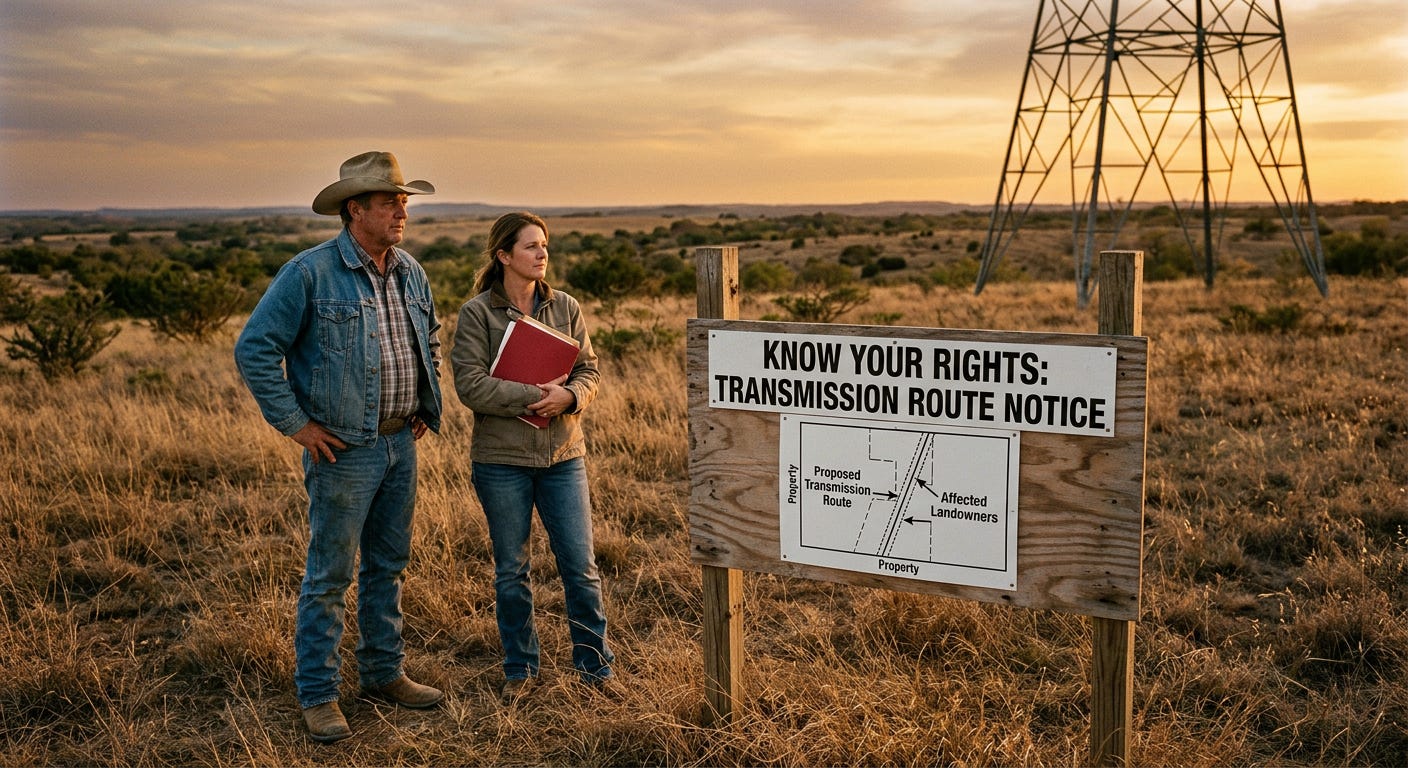
Across the country, electric utilities and grid operators are racing to build high‑voltage transmission lines. Surging regional demand, industrial expansion, and the relentless rise of hyperscale data centers have pushed extra‑high‑voltage corridors — including proposed 765‑kV lines in Texas — through regulatory channels at breakneck speed.
To keep pace, state regulators rely on compressed statutory review windows. But in the rush to get steel in the ground, project sponsors are making a strategic mistake: treating due process and local public participation as administrative hurdles rather than core components of infrastructure delivery.
Texas now offers the clearest example of what happens when that mistake becomes visible.
More than 200 landowners, ranchers, and county officials packed a 15‑hour legislative hearing in Austin to challenge the fairness of the state’s 765‑kV routing process, according to reporting from KUT. Their message was simple: the grid may need expansion, but the process for deciding where that expansion goes is fundamentally unbalanced.
As San Saba County landowner Paul Grimmie told lawmakers:
“This process should not move so quickly that due process becomes collateral damage.”
The 180‑Day Procedural Asymmetry
The conflict in Texas is not about whether the grid needs reinforcement — most stakeholders agree it does. The conflict is about how the routing process distributes burdens.
Texas’s current system creates a structural imbalance:
Years of Preparation vs. Weeks to Respond
Utilities spend two to three years modeling routes, conducting environmental assessments, and preparing filings. Once a Certificate of Convenience and Necessity (CCN) is submitted, affected landowners often have 30 days to intervene, hire counsel, review thousands of pages, and propose alternatives.
The Legal Disadvantage
Many landowners receive dense, legalistic notices that are difficult to interpret without specialized help. Those who fail to intervene early lose procedural rights they didn’t know they had.
The Mid‑Stream Ambush
When a transmission provider shifts a route segment mid‑proceeding, newly affected neighbors may receive no fresh notice — yet suddenly find themselves inside the corridor.
As NBC 5 Dallas–Fort Worth reported , landowners described being pulled into the process late, confused about deadlines, and unable to secure representation in time.
When ordinary citizens balancing jobs, families, and agricultural operations are forced into a hyper‑technical legal arena under a compressed deadline, they naturally conclude the game was rigged before the first hearing began.
Why Process Failures Guarantee Project Delays
Utilities often assume that shorter statutory windows accelerate construction. In reality, a process perceived as illegitimate is the single greatest driver of long‑term delay.
When communities feel steamrolled, they don’t simply accept the outcome — they adapt:
Organized legal defense
Legislative and judicial pushback
County‑level moratoria
Political pressure to halt approvals
A “fast‑tracked” 180‑day window that leads to three years of appeals, injunctions, and hostile county boards is not a fast project. It is a stalled project.
Texas’s hearing made one thing clear: reliability evidence will not resolve objections rooted in property rights.
The 4 Pillars of a Due‑Process Strategy
If developers and state utility commissions want to build thousands of miles of new transmission, they must recognize that notice quality, landowner assistance, route‑change rules, and adjacent‑property protections are as essential to delivery as engineering studies.
Here are the four practices that restore legitimacy — and protect timelines:
1. Parcel‑Level Transparency Early On
Replace dense legal notices with accessible parcel‑level mapping tools and plain‑language explanations of rights, valuation methods, and timeline milestones before filings occur.
2. Independent Technical Assistance
Provide unrepresented landowners with access to neutral advisors or educational workshops (such as extension‑service programs) so they can evaluate route alternatives without feeling blind‑sided.
3. Automatic Re‑Notification Triggers
Require renewed notice and extended response windows whenever a route segment is materially altered or shifted toward a previously unnotified parcel.
4. Protections for Non‑Host Neighbors
Address impacts on adjacent properties — viewsheds, irrigation systems, agricultural operations — rather than ignoring owners who suffer real effects simply because no easement was taken.
These are not “nice‑to‑have” practices. They are the procedural infrastructure that makes physical infrastructure possible.
The Bottom Line
A detailed load‑flow study proves why a transmission line is needed. Procedural fairness determines whether that line ever gets built.
Treating due process as collateral damage in the name of speed isn’t an operational shortcut — it is the fastest way to lose the local narrative and shut down critical infrastructure.
Texas is showing the country what happens when routing outpaces legitimacy. The next decade of grid expansion will be defined not only by megawatts, but by whether communities believe the process respects their rights.
Call to Action
If you work in energy, land use, or infrastructure policy, this moment demands leadership — not just engineering. Subscribe to Politely Losing to follow how procedural legitimacy is reshaping transmission, data‑center siting, and the politics of modern grid expansion.
Subscribe, share, and join the conversation. The grid we build will reflect the process we choose.
Further Reading