

54 Moratoria and Counting: Why Data Centers Are Losing Their Social License
Treating hyperscale AI facilities like ordinary industrial real estate is a failing playbook. Communities are locking the front door until developers account for cumulative resource strains.

Summary
Data centers were once sold to local governments as low-impact industrial neighbors: quiet buildings, little traffic, strong tax revenue, and no new school demand. The AI buildout has changed that bargain. Hyperscale facilities now arrive with enormous power requirements, water concerns, backup generation, noise questions, and grid-cost implications that communities are no longer willing to treat as routine land-use issues.
The result is a growing wave of moratoria. Montgomery County, Maryland, recently approved an 18-month pause on new data center permits so officials can develop standards for siting, infrastructure, water, noise, and ratepayer protection. Nationally, policy organizations are documenting a broader shift: opposition is moving from individual project fights to systematic pauses designed to reset the rules before the next wave of development arrives.
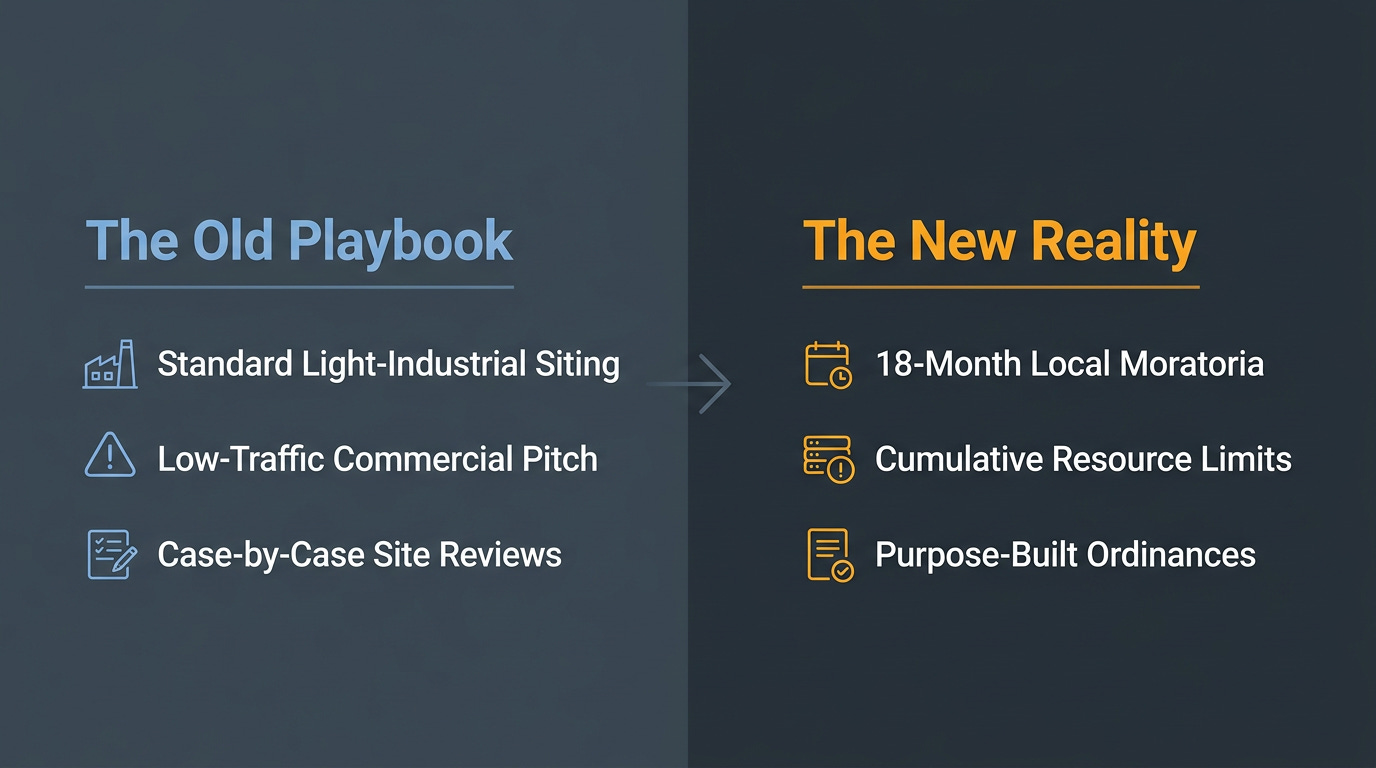
For years, commercial real estate developers had a reliable pitch for local county boards: data centers would bring substantial tax revenue without the usual residential burdens. No school-aged children. Minimal traffic. Quiet buildings tucked behind tree lines. In the land-use world, that sounded like the ideal light-industrial deal.
That pitch worked—until artificial intelligence changed the scale of the industry.
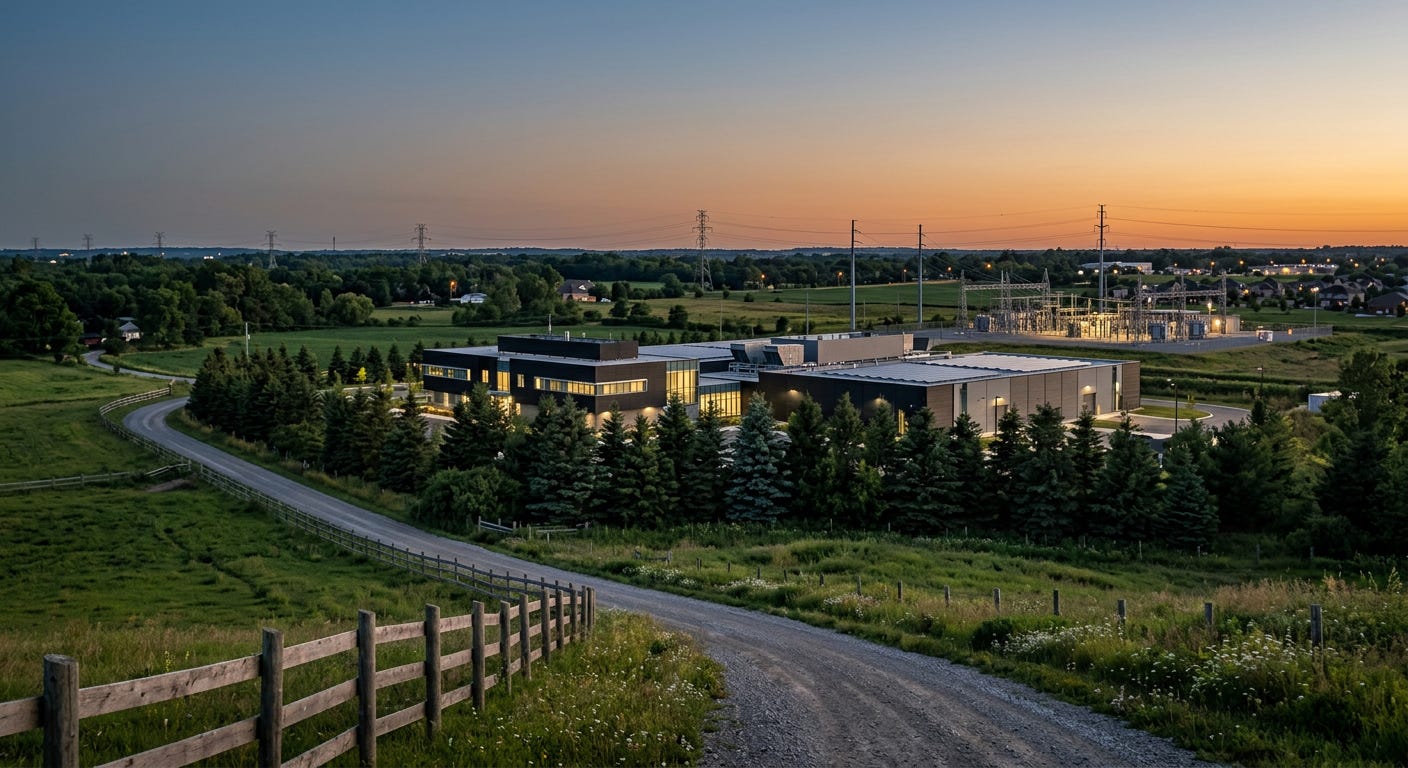
Today’s hyperscale data centers are not simply windowless warehouses full of servers. They are high-voltage infrastructure campuses with massive electricity needs, cooling demands, backup generation, and regional consequences. Local officials and residents are beginning to see them less as passive real estate assets and more as utility-scale projects that can reshape power planning, water use, ratepayer exposure, and community character.
The political reaction has been swift and revealing: the local data center moratorium boom is here.
From Project Battles to Legislative Pauses
When an industry loses its social license, opposition stops being confined to individual site plans. It becomes procedural. Communities stop asking whether this particular project should be approved and start asking whether the rules themselves are adequate.
Montgomery County, Maryland, offers a clear example. The County Council unanimously approved an 18-month moratorium on new data center permits, extending an earlier executive pause and giving county leaders time to write more durable standards for large-load facilities. The immediate backdrop was a proposed data center campus in Dickerson, but the policy response was broader than one project.
This is the important shift. Instead of treating each data center proposal as a discrete zoning matter, local governments are beginning to freeze approvals until they can answer bigger questions: Who pays for grid upgrades? How much water will be used in peak conditions? What happens to nearby property owners? What safeguards protect residential utility customers? Across the country, those unanswered questions are rapidly eroding the industry’s social license.
The Property Rights Tension Runs Both Ways
Moratoria are politically popular because they sound temporary and cautious. But they also expose a deeper property-rights tension on both sides of the fence.
· The local government and community view: Host communities argue they have the right to pause development long enough to protect shared infrastructure, preserve groundwater and surface-water resources, limit noise and emissions, and prevent residential ratepayers from subsidizing new utility capacity.
· The developer and landowner view: Developers and private landowners argue that sudden legislative freezes disrupt negotiated transactions, chill capital investment, undermine expected land value, and change the rules after substantial planning has already occurred.
Both arguments deserve to be taken seriously. But when developers respond by insisting that a 300- or 500-megawatt campus is “just another warehouse,” they reinforce the very concern driving the backlash: that the industry wants ordinary zoning treatment for extraordinary infrastructure impacts.
The New Playbook: Transparent Resource Budgets Before Site Plans
If hyperscalers and data center developers want to restore trust, they need to stop leading with the old commercial real estate script. The “low traffic, high taxes” pitch is no longer enough.
Before filing a zoning application or site plan, developers should publish a transparent resource budget that answers the community’s core questions in plain language:
1. Power and grid protection: Quantify peak megawatt demand and show, through enforceable tariffs or rate protections, that residential customers will not subsidize the new substation, transmission upgrades, or capacity costs.
2. Water infrastructure: Disclose expected annual water consumption under peak summer conditions and explain whether closed-loop, reclaimed-water, or dry-cooling alternatives can reduce local watershed pressure.
3. Acoustic and environmental controls: Provide realistic noise modeling for cooling systems and backup generator testing, with enforceable limits at neighboring property lines.
4. On-site infrastructure capital: Commit to funding the necessary substations, interconnections, and site-specific utility upgrades rather than shifting those costs to municipal taxpayers or residential ratepayers.
Key Takeaways
· Data centers are no longer being evaluated as ordinary industrial buildings. Communities increasingly view them as energy- and water-intensive infrastructure assets.
· Moratoria are a symptom of lost trust. Once local governments pause approvals across the board, the debate has moved beyond one project.
· The core political issue is cumulative impact. Residents are asking who pays for power upgrades, who bears water risk, and who absorbs noise, emissions, and ratepayer exposure.
· Developers need a new approval strategy. The next successful projects will lead with transparent resource budgets, enforceable safeguards, and early community engagement.
The Bottom Line
A data center is not a warehouse. It is an energy- and water-intensive utility asset wrapped in a real estate transaction.
Developers who continue to treat local communities as passive hosts will encounter more closed doors, longer pauses, and tougher entitlement battles. The path forward requires moving past glossy PR boards, publishing clear resource limits early, and building local trust before asking for a permit.
Call to Action
If your community is facing a proposed data center, do not start with slogans. Start with questions. Ask for the peak power demand, the water budget, the ratepayer protections, the noise model, and the developer’s written commitment to fund the infrastructure it needs. And if you are a developer, publish those answers before the first public hearing—not after opposition has already organized.
Social license is not granted by a zoning code. It is earned in public, before the permit fight begins.